Read the Room: What DJing and Community Building Have in Common
I learned to DJ in my fifties.
That's a sentence I genuinely didn't expect to write. But here I am.
I’ve created Studio 17, a DJ collective based in Walthamstow and have learned to beatmatch, build a set, work a room and build a safe, inclusive, joyful, intergenerational space to party.
I spent my youth at raves, festivals and house parties. I was always the person hosting the party with the vinyl records, mixtapes, CDs, then the Spotify playlists. The music formats have changed, but I have never stopped wanting to play and dance to music with others.
Every time I build a DJ set or plan a party I think about how being a good DJ and being a good community builder draw on remarkably similar skills, instincts, and values.
I've spent years helping organisations build and grow communities. I've thought carefully about what makes a community thrive versus flatline. And as I've started to understand what makes a DJ set really work.
I keep seeing the parallels.
So let me walk you through them.
You have to know your people
The first thing any DJ learns is to read the room.
It doesn't matter how much you love a particular track. If the room isn't feeling it, you move on. You adapt. The set is never about you and your taste alone, it's about what the people in front of you need, right now, in this moment.
This is identical to one of the most important principle in community strategy: community market fit.
Community market fit is about understanding whether your community's purpose and design genuinely aligns with the people you want to bring together. A community that serves its members' needs, not just the organisation's goals, is one that will grow and sustain itself. One that doesn't read the room will empty quickly.
Before you build, before you programme, before you press play: know your people.
You need a reason to gather
Every great DJ set has an arc. A journey. A feeling. A purpose. Even at its most euphoric and unplanned, a set has an intention behind it.
Communities need the same thing. I call it community purpose, the formal statement of why a community exists and what it's trying to achieve. If you can't articulate why people should come together, they won't. Or they will, briefly, and then they'll drift away.
Studio 17 has a purpose: it's a space for women of a certain generation to learn, create, support each other and make music together. That's our community purpose. It's simple. It's clear. And everyone who joins understands immediately whether it's for them.
The same principle applies whether you're building a brand community, a professional community of practice, or a grassroots local group. What's the point of pressing play if nobody knows why they're in the room?
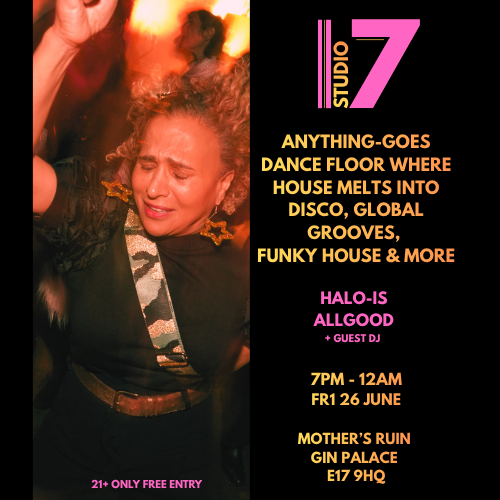
Studio 17 flyer June 2026
Photo by Ian Falconer©
The dancefloor is a Third Place
Think about the best events you've ever been to. The warehouse rave. The festival field. The house party that ran until dawn. What made them special?
It wasn't just the music. It was the way they dissolved the usual social hierarchies. You didn't know what anyone did for a living. It didn't matter. What mattered was being present, being together, moving together.
This is almost exactly what sociologist Ray Oldenburg described when he coined the concept of the Third Place , a space distinct from home (the First Place) and work (the Second Place), where conversation is informal, community bonds form naturally, and status is transcended. Oldenburg's examples were pubs, cafes, hairdressers. He could just as easily have included the dancefloor.
I grew up going to raves in the late 80s and early 90s. What I experienced there, the collective joy, the dissolution of ego, the feeling of being part of something that transcended the everyday, was Third Place thinking in action. Nobody needed a name badge. Nobody needed a job title. The music was the invitation, and everyone who turned up had accepted it.
The best communities I've worked with create that same feeling. They are genuinely equalising spaces. The most senior person in the room and the newest member both feel welcome, both feel seen.
As a DJ, your job is to create that space. As a community builder, it's exactly the same.
Rituals matter more than you think
Every experienced DJ knows the power of a ritual moment. The drop that everyone anticipates. The anthem that signals something. The track you always close with.
Rituals create a shared experience. They give community members something to look forward to, something to return for. And something to talk about afterwards.
In community building, rituals are one of our most powerful tools in the kit. The best communities I've worked with have regular, recurring moments that bond their members: the monthly spotlight, the weekly check-in, the annual gathering. These aren't just programming tactics, they're the heartbeat of a community. They tell members: we're still here. You still belong.
In a DJ set, when you play a track that a crowd recognises and loves, the hands go in the air and the room transforms.
In a community, when a ritual lands right, something similar happens. People lean in. They feel it.
You can't fake energy, and you can't manufacture trust
The worst DJ sets I've ever experienced were ones where I could feel the DJ wasn't really with us and were simply going through the motions.
The worst communities I've encountered have the same problem. They're technically functional. There's a platform, posts and members, but there's no genuine human effort or investment behind them. And people feel it immediately.
Community trust is earned over time through consistency, care, showing up and evolving. It's what transforms a group of individuals into a community with genuine community health. That hard-to-define but easy-to-sense quality that tells you a community is genuinely thriving.
It's also what Robert Cialdini's principle of reciprocity speaks to: people are hardwired to reciprocate genuine care and investment. When community managers and hosts give their time, effort and warmth to the community, members give back. A dancefloor responds to a DJ who gives everything. A community responds in kind.
It’s a journey, but the onboarding moment is critical
In DJing, the opening of a set is critical. You can't open cold and expect a room to warm to you. You need to earn trust quickly, to signal what you're about, to make people feel safe, to make them feel like they're in the right place.
And your opening tune may not be a ‘banger’ (a well recognised, hands in the air, big tune) . The best DJs will open with a tune that makes the crowd think “hey..this is an interesting track.I don’t know it. I think I like it. I’m interested. Tell me more.”
In community building, onboarding is one of the most important things you'll ever do. The first experience a new member has of your community shapes everything that follows. A warm welcome, a clear sense of community purpose, an introduction to the norms and values, these reduce Fear, Uncertainty and Doubt (what I call FUD in my community glossary) and increase the chances that a new member becomes an active, engaged one.
New members are the equivalent of first-time visitors at a venue. Their future relationship with the space depends on how that first night feels. Get it right, and you have someone who'll come back, bring their friends, and become part of the fabric of the place.
Get it wrong, and they won’t return.
The Expansion Effect: when bigger stops being better
Here's something that every experienced DJ understands: intimacy matters.
There's a reason some of the best sets happen in small rooms. My favourite nights of dancing have been in the back rooms of unknown pubs, the smaller tents at festivals, or impromptu house parties at friends of friends. Not at megaclubs.
At a certain size, a crowd stops being a community and starts being an audience. The connection between the DJ and the room and between dancers thins out. The magic is harder to sustain.
I've written about what I call the Expansion Effect in community strategy. This phenomenon is where the perceived value of a community reduces as the community grows too large. Growth can disrupt the norms, the warmth, the sense of being known, that made the community valuable in the first place.
This isn't an argument against growth. It's an argument for being intentional about it. Sometimes the best move is to create a smaller room, a sub-community or a micro community, where intimacy can be maintained. Sometimes you need to think carefully about what your community looks and feels like at scale.
Studio 17 is a small, tight-knit collective. Its power comes partly from that. Everyone at our nights knows each other, or makes friends quickly when they arrive for the first time. We haven't needed the Expansion Effect yet, but understanding it means we'll manage it thoughtfully when we do.
You're always co-creating
The biggest misconception about DJing is that it's a solo performance. It isn't.
Every great DJ set is a conversation between the DJ and the room. The crowd responds, you adjust. You take risks, the crowd signals whether they land. It's a live, continuous act of co-creation.
The same is true of great communities. The best community managers aren't broadcasting at their members, they're in genuine dialogue with them. They're listening for signals, adjusting their approach, inviting members to help shape what the community becomes.
This is what community generated content (CGC) and collaborative events are really for. They're the mechanisms by which a community stops being something done to members and becomes something created with them. You'll find all of these terms, and many more, in my community glossary.
The dancefloor teaches you this fast. If you're not listening, you'll feel it. The energy drops and the room empties.
Look up from your decks and your mixing. Look and Listen.
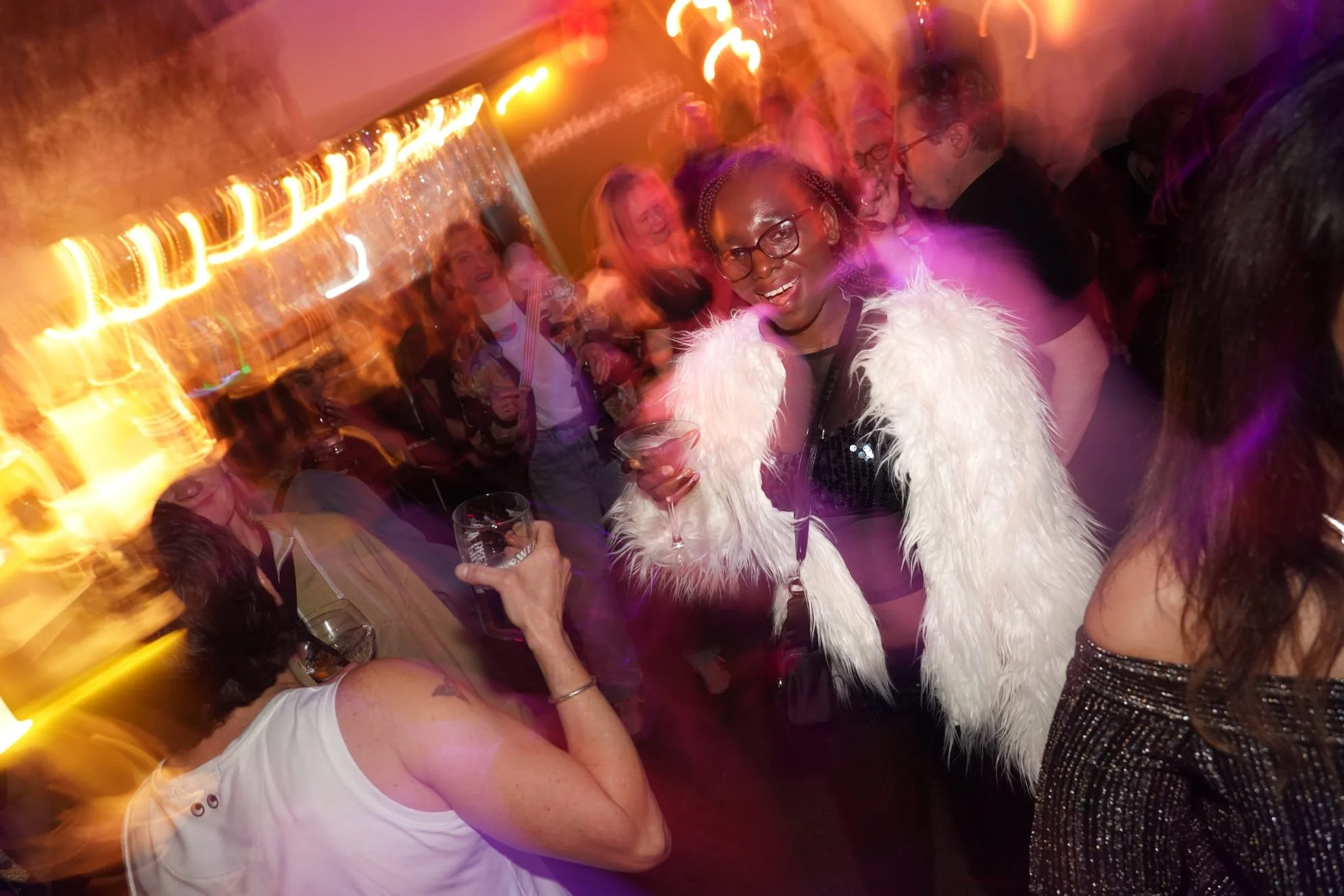
The Studio 17 dancefloor
Photo by Ian Falconer©
Why this matters now
I said at the start that I learned to DJ in my fifties. I want to say something about why that happened, and why I think it matters beyond the personal.
We are living through an extraordinary moment of technological change. AI is reshaping how we work, create and communicate. I'm fascinated by it, and I work with it daily. I’m seeing first hand the impact it is having on my and my children’s careers and livelihoods. It is both negative and positive.
“As AI advances, the things that make us most distinctly human become more important, not less. Shared physical experience. Dance. Joy. Connection. The feeling of being in a room full of people moving together to music that matters to you. Creating a mass of energy and a moment of release in time that hopefully isn’t captured on a thousand mobile phones.”
The late 80s rave scene that shaped me was, in many ways, a response to the social conditions of its time. People found each other. They created spaces. Many were unofficial and underground. Spaces where they could be free, connected, and joyful. Together.
It feels at this big moment of political polarisation, societal and technological change that we need that again.
And I believe that the very human-centred skills of the community builder and the DJ; reading the room, creating purpose, building rituals, earning trust, co-creating with the people you serve are among the most human skills there are.
Studio 17 is, in its own small way, a community of purpose. A community of play. A community of place, rooted in Walthamstow. It's a growing Third Place where people can connect, kick back, support each other, and most importantly find some joy.
And if that isn't community building, I don't know what is.
Thank me / Hire me
Are these articles helpful to you?
Please do contact me if you’d like to discuss any aspect of community building or if you want support with your community strategy. I’m happy to discuss both small and large projects.
Want to book Studio 17?
Inclusive E17 DJ collective focusing on feel good sets packed with disco,vocal house,funk + dance classics. DM on Instagram for booking enquiries. Follow for updates. 🪩 💕
Further reading
I’ve created a community glossary and I also explain key concepts in community strategy, community building and community management.
Here are some connected articles that you may find helpful:
What is the ‘Expansion Effect’ in Community Strategy?
The ‘Third Place’ - what is it and how can we apply learnings to community building?
Is it possible to create a successful consumer brand without community?
Transactional analysis in community
Why Community is a Business Moat
What is a Community Qualified Lead (CQL)? And how does it differ from a MQL or PQL?
What is Community Everywhere / what are Community Ecosystems?
What is Community Led Growth - is it the same as Community Based Marketing (CBM)?
What is Community Market Fit?
What is Minimal Viable Community (MVC)?
What are rituals in community building and why are they so important?
What are the 5 Ps and 1 C of community?
What is Broken Windows Theory and does it apply to Community Management?
Why we need to ban the term ‘lurkers’ in community strategy
What is Community Manager Appreciation Day (CMAD)?
The Definitive Community Glossary - A - Z
Book a Free Consultation
Want help or support with your community strategy or community building? I’m ready and waiting to hear from you. Book an introductory call to speak to me about your challenges and questions you might have.
Photos by Ian Falconer© and Michelle Goodall ©